
At Midnight
Exodus 12:29–42

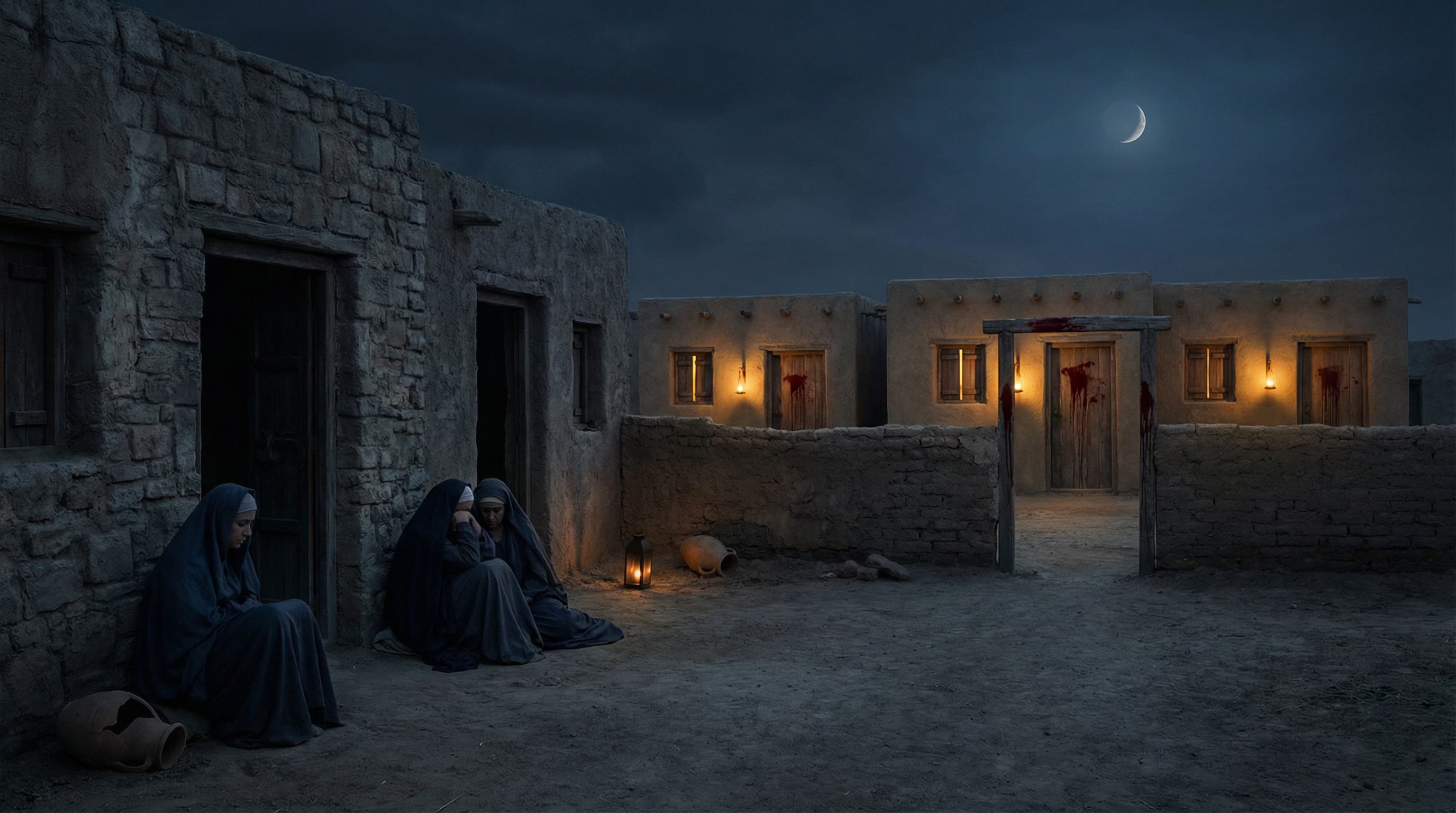
It happened exactly when God said it would.
“At midnight the LORD struck down all the firstborn in Egypt, from the firstborn of Pharaoh, who sat on the throne, to the firstborn of the prisoner, who was in the dungeon, and the firstborn of all the livestock as well” (Exod 12:29).
One sentence. That’s all the text gives us. No dramatic buildup. No slow-motion cinematic sequence. Just a single, devastating line—and then the wailing began.
“There was loud wailing in Egypt, for there was not a house without someone dead” (Exod 12:30).
Every house. Every family. From the palace to the prison. Pharaoh had been warned nine times. He refused nine times. And now the tenth plague had come, and it didn’t negotiate.
It’s tempting to rush past this moment to get to the triumphant exodus. But we shouldn’t. This is holy ground, and it’s heavy ground. Real families lost real children that night. The text doesn’t let us look away from that. God’s judgment is not a sanitized abstraction. It costs something. It always has.
And that’s exactly why we need a Lamb.
Somewhere in Goshen, Israelite families huddled behind blood-painted doors, eating roasted lamb with their sandals on, listening to the silence that meant death had passed over their homes. They didn’t escape because they were better people. They escaped because they trusted the blood.
That’s the gospel hiding in plain sight. Judgment fell. But it fell on the lamb instead of the firstborn. Substitution. Sacrifice. Salvation through blood and faith.
By the time the sun rose, Pharaoh had finally broken.
“Up! Leave my people, you and the Israelites! Go, worship the LORD as you have requested. Take your flocks and herds, as you have said, and go. And also bless me” (Exod 12:31–32).
That last line always stops me. “And also bless me.”
The most powerful man in the ancient world, surrounded by death, begging the slaves he once oppressed to ask their God for a blessing on his behalf. Pride can only hold out so long. Eventually, reality wins.
The Egyptians couldn’t get Israel out fast enough. They shoved silver and gold into Israelite hands—“whatever you want, just go.” The text says the Israelites “plundered the Egyptians” (Exod 12:36). Not by force. By favor. God had promised Abraham his descendants would leave their captivity with great possessions (Gen 15:14). Four hundred years later, the promise showed up in armfuls of Egyptian wealth.
And then they walked out.
Six hundred thousand men, plus women and children, plus livestock, plus “many other people” who joined them (Exod 12:38)—a mixed multitude, streaming out of Egypt after 430 years to the day.
Let that sink in. To the day.
God keeps time differently than we do. Four centuries of silence. Four hundred years of slavery. And then, on the exact day he had appointed, the exodus began. Not a moment late. Not a detail forgotten.
If you’ve been waiting for God to move—if you’ve been wondering whether he remembers his promises—this passage has something to say to you. The same God who counted 430 years to the day is counting your days too. His silence isn’t forgetfulness. His patience isn’t neglect. He’s working on a calendar you can’t see.
Israel left Egypt at night. They walked out in the dark, carrying dough that hadn’t risen and borrowed gold they hadn’t earned. They didn’t have a map. They didn’t have a plan. They just had a God who said, “Go,” and a cloud that would show up soon enough to guide them.
Sometimes that’s how deliverance works. You don’t get the whole route. You just get the next step.
And the next step out of Egypt was enough.
The Long Faithfulness
A Poetic Reflection on Exodus 12:29–42
Let us be honest
about the thing
the comfortable gospel leaves out:
God is not safe.
His judgment is not a metaphor.
It is not a holding place
for people who need more therapy.
It is the holiness of a God
who meant what he said
in the garden,
at the flood,
at the foot of a mountain
that shook so hard
even Moses trembled.
He does not wink at sin.
He does not grade on a curve.
The debt was real
and the wages were death
and no amount of effort
or goodness
or trying harder next Monday
was ever going to balance the account.
So he sent a substitute.
Not a system. Not a philosophy.
A Son.
A lamb on an altar
that Abraham’s hand
was never meant to reach.
A body on a cross
absorbing every consequence
your life had earned
so that the judgment
that was aimed at you
would land on him instead.
This is not a transaction.
This is a father
stepping between his child
and the thing his own justice required,
and paying it himself.
And then—the waiting.
Because God does not work
on your calendar.
Abraham waited twenty-five years
for the son he was promised.
David waited fifteen
between the anointing and the throne.
Israel waited four hundred
between the last prophet
and the cry of a baby
in a borrowed feeding trough.
And every single time,
the promise came.
Late by human measurement.
Perfect by his.
So if you are standing
in the long middle—
past the promise
but before the proof—
do not confuse the silence
with absence.
He kept his word to Abraham.
He kept his word to David.
He kept his word at Calvary
when the sky went black
and it looked like death had won
and three days later
the answer walked out of a grave.
He will keep his word to you.
Not because you have been patient.
Because he has always been faithful.
This is holy ground, and it’s heavy ground.
That’s the gospel hiding in plain sight.
To the day.
He’s working on a calendar you can’t see.